Why Arizona attics need this
Arizona heat is a different animal. Outside in late June, Phoenix sits at 110°F and Tucson around 102°F, but the number that actually matters is what is happening four feet above your ceiling drywall. Attic probes in Maricopa County have read 160°F on the worst afternoons. That is pure radiative load, not humid heat. The desert air outside is dry, so there is no moisture buffer slowing the temperature climb. The sun just hammers the shingles or tile from sunup until almost 8pm, and the attic stores every bit of it.
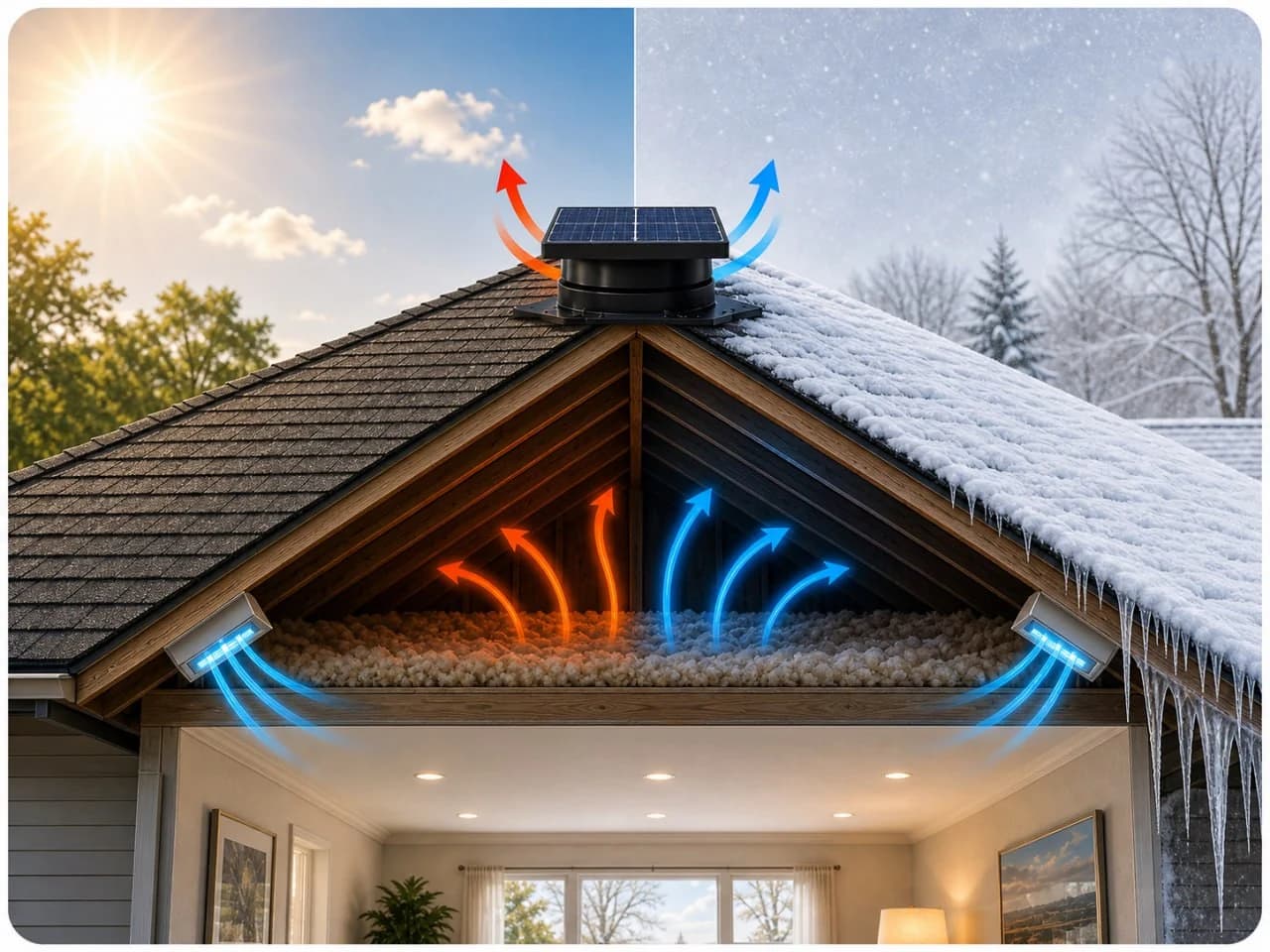
That stored heat radiates down all evening. It is why the back bedroom in a Gilbert ranch still feels warm at midnight even though the thermostat reads 78°F. Your AC runs late into the night chasing an attic that will not let go of the day. Then monsoon season rolls in from July through September, sudden afternoon storms break the dry pattern for an hour, and the attic goes right back to baking the moment the clouds clear. Insulation slows that heat. It does not move it. The fix is to push it out.
What we install
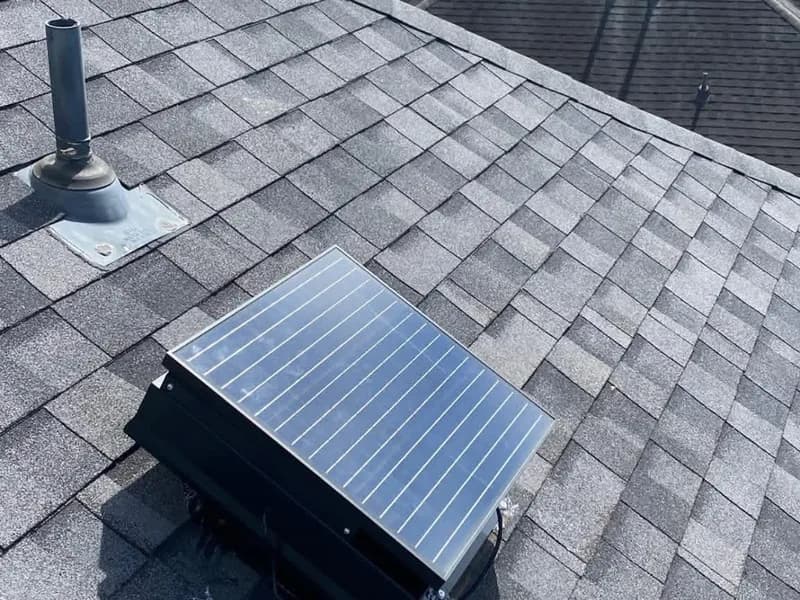
You get one 30W solar attic fan, sized for an Arizona home, paired with an authorized installer who handles the install. The solar panel is built into the housing, and the housing itself is UV-stabilized for the kind of sun that destroys cheap plastic vents in two summers. Most attic-vent failures we see on older Phoenix and Mesa roofs are sun-cracked plastic turbines, not the fan motor. Our unit is built to live in that UV.
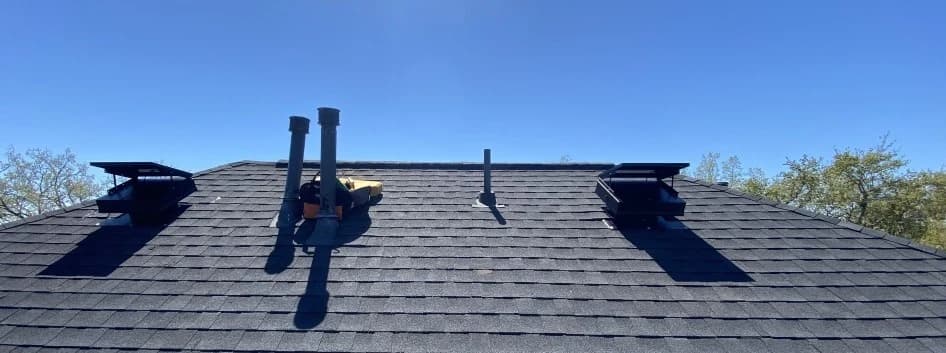
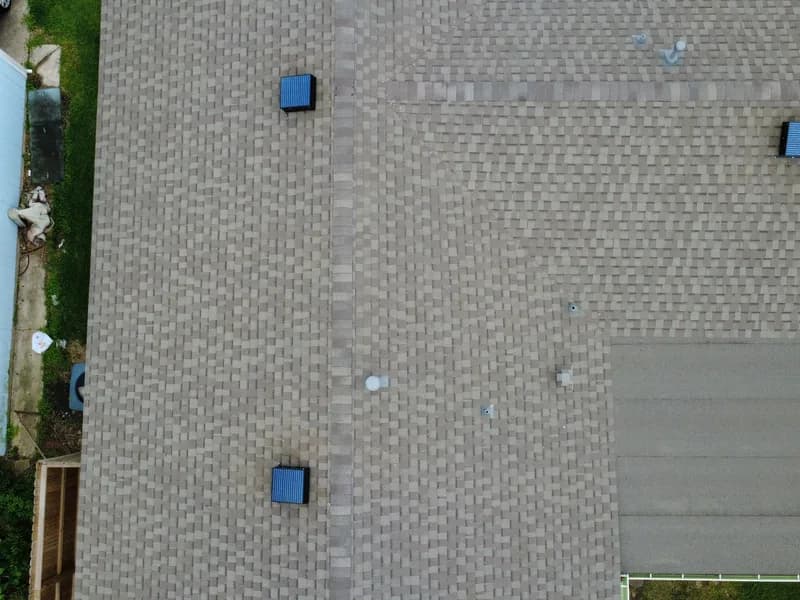
The installer mounts it on the back slope so it stays hidden from the street, cuts a clean opening, seals it for monsoon wind-driven rain, runs a thermostat and a humidistat, and ties off the flashing tight to whatever you have up there, asphalt or concrete tile. Professional install in a single visit. No electrician, no new circuit. Sun hits the panel, the fan spins, and a lot of trapped attic air moves out.
What you'll save
The average Arizona home uses about 10,500 kWh per year. That looks low next to Texas or Florida, but the catch is when you use it. Roughly two thirds of an Arizona power bill lands between May and September, and a typical summer bill sits near $240 in July or August with peak-rate pricing on top.
Owners who put a solar attic fan on an Arizona home usually see a 15 to 25 percent drop in summer cooling cost (per U.S. Department of Energy residential cooling-load guidance). On a $240 August bill, that is $36 to $60 back in your pocket that month. Arizona's cooling season runs roughly May through October, so six months of savings stack up fast. The bigger long-game payoff is the roof itself. Asphalt shingles in Phoenix often only last 13 to 15 years because they cook from underneath. Cool the attic dramatically and you buy real years back on the roof, before the fan's own warranty runs out.
Real Arizona install scenarios
Phoenix, Arcadia neighborhood. A 1960s ranch with original concrete tile, low-pitched roof, and almost no soffit ventilation by modern standards. The owner kept her thermostat at 78°F but the west-facing bedrooms behind the saguaro hedge still hit the mid 80s by 6pm. We pulled an attic probe reading of 158°F on a 109°F afternoon in late June. The installer set the fan on the back tile slope using a tile-specific flashing kit so no tile got cracked. Within two weeks the probe was reading 122°F at the same hour, and the back bedrooms tracked the rest of the house within 2°F by sundown.
Tucson, Catalina Foothills. A two-story stucco home perched on the lower foothills with dark architectural shingles and serious western sun exposure straight down the Sonoran corridor. Tucson sits about 1,500 feet higher than Phoenix, so nights cool faster, but the attic was still trapping 148°F by 4pm in July. The upstairs office was unusable. We mounted the fan high on the back slope to catch the longest solar window. The owner reported her July bill dropped from $268 to $204, and her office became workable again before lunch instead of after sundown.
Gilbert, Power Ranch. A newer master-planned home with dark composite shingles, an HOA that does not allow visible roof equipment from the street, and an attic that read 152°F on the install crew's probe in early August. We placed the fan on the rear-facing slope above the garage, well below the ridge line so it stays invisible from the curb, and ran the HOA paperwork before showing up. The owner texted us a week later: the upstairs game room dropped from 84°F at 7pm to 79°F at 7pm, and the AC stopped running through the night for the first time that summer.
Installed by Arizona authorized installers
Newer master-planned HOA communities in Gilbert, Chandler, and north Scottsdale have placement rules so the unit cannot be seen from the front. Our installers default to back-slope placement, which clears almost every HOA rule we have seen. You pick a date, the installer shows up, and your attic stops cooking.